On the morning of June 7, Professor Zhao Libin, a “Changjiang Scholar” Distinguished Professor appointed by the Ministry of Education and Dean of the School of Mechanical Engineering at Hebei University of Technology, was invited to visit our school for academic exchange. She delivered an academic lecture titled “Failure Theory and Prediction Methods for Advanced Composite Joined Structures” in Lecture Hall 3 of the Conference Center. The lecture was chaired by Professor Zhang Zhongqiang, Dean of the School of Mechanical Engineering, and attended by more than 90 people, including Professor Ye Yunxia, Vice Dean; representatives of young faculty members; and master’s and doctoral students.
At the start of the event, Dean Zhang Zhongqiang extended a warm welcome to Professor Zhao Libin and provided a detailed overview of her academic background and outstanding achievements in the field of structural failure theory and strength prediction for advanced composite materials, as well as her engineering accomplishments in tackling major aerospace projects. Dean Zhang noted that this lecture is of great significance for broadening the academic horizons of faculty and students in the field of composite materials and lightweight structural design, and for promoting interdisciplinary innovation between mechanical engineering and aerospace.
During the lecture, Professor Zhao Libin began by discussing the developmental context of composite structures in aircraft. She systematically analyzed the evolution of composite materials in aircraft structures—from non-load-bearing and secondary load-bearing applications to primary load-bearing roles—emphasizing that joint structures are key to achieving larger-scale and monolithic designs, yet also represent a weak link in load-bearing capacity. Focusing on her team’s research achievements in the static strength of composite structures, joint structures, and fatigue issues, she elaborated in depth on the failure theory established to address the progressive failure characteristics resulting from the coupling and propagation of multi-scale, multi-damage-mode mechanisms: by decoupling in-plane failure from interlaminar failure, theories of static strength, fatigue strength, and damage tolerance were developed; For complex joint configurations such as bolted joints and non-planar adhesive bonds, she proposed a series of high-precision strength prediction methods. In the sections on platform development and recent research, Professor Zhao presented the latest advancements in cutting-edge areas such as intelligent monitoring of aircraft structures throughout their full life cycle, digital twins, digital and intelligent experiments, and intelligent maintenance robots. Finally, she summarized and looked ahead to the future development of composite structural strength theory, emphasizing that theoretical research must be deeply integrated with engineering applications. Professor Zhao Libin’s presentation was comprehensive and logically rigorous, combining profound theoretical depth with a strong focus on practical aerospace engineering applications. It effectively addressed knowledge gaps among faculty and students in the field of damage analysis for composite joint structures and provided important insights for future scientific research.
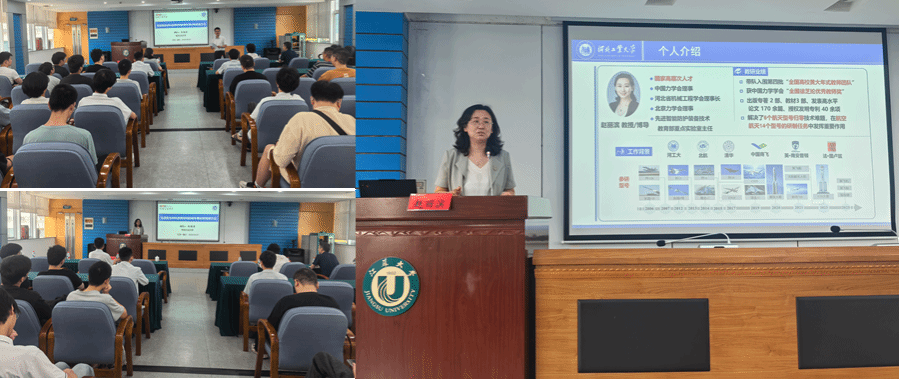
During the interactive Q&A session, faculty and students in the audience actively asked questions based on their respective research interests. Professor Zhao Libin provided detailed answers to each question and engaged in in-depth discussions on topics such as the fatigue life prediction and engineering applications of composite materials, while also offering targeted research advice to young scholars and graduate students. The successful hosting of this lecture further enriched the school’s academic exchange activities, fostered a vibrant atmosphere of scientific research and innovation, broadened the academic horizons of faculty and students in the fields of advanced composite materials and intelligent equipment, and injected new momentum into the school’s research development in these areas.