Liquid Crystal Elastomers (LCEs), as intelligent materials that combine the elasticity of polymer networks and the anisotropy of liquid crystal mesogens, can undergo a reversible transition of liquid crystal mesogens from the nematic phase (ordered state) to the isotropic phase (disordered state) under external stimuli (such as temperature, light, electric field, etc.). This transition further drives the polymer network to produce macroscopic deformations (such as contraction, bending, etc.). Benefiting from their high driving strain, programmable deformation capability, and reversible response characteristics, LCEs show significant potential in the fields of artificial muscles, soft robots, and flexible actuators.
Aiming at the current challenge that the thermally induced deformation of LCEs is limited by excessively high driving temperature thresholds (generally exceeding 80°C), recently, the research teams led by Professor Xu Lin and Professor Ding Jianning from Jiangsu University, in interdisciplinary cooperation with Associate Professor Tao Ran from Beijing Institute of Technology and Professor Franck from the University of Colorado (USA), have successfully developed a new type of human body temperature-driven ultra-stretchable liquid crystal elastomer with breakthrough performance. This study innovatively proposes a spiral programming orientation preparation technology. Through a two-stage thiol-acrylate Michael addition and photopolymerization reaction, an ultra-stretchable liquid crystal elastomer with a preprogrammed strain of up to 2500% was developed, surpassing the strain limit of traditional liquid crystal elastomers. Particularly noteworthy is that the ultra-stretchable liquid crystal elastomer actuator (LCE-25) prepared on this basis exhibits excellent low-temperature driving characteristics, which greatly reduces the response temperature required for LCE actuators and enables thermally induced deformation at a rate of 16.75°/s within the driving temperature range of 25~33°C. This research was published in the internationally renowned TOP journal Advanced Functional Materials (Impact Factor: 18.5) under the title "Body temperature actuated liquid crystal elastomers from hyper tensile preprogramming".
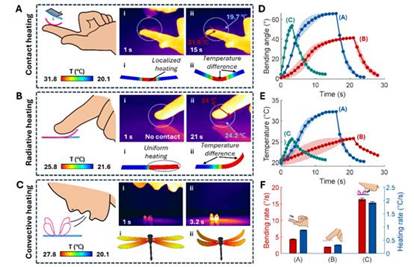
Figure 1: Human body temperature-driven performance of LCE-25. (A) Finger contact enables heat conduction heating of LCE-25, resulting in thermally induced bending deformation. (B) Finger following enables heat radiation heating of LCE-25, resulting in thermally induced bending deformation. (C) Human respiration enables convective heating of LCE-25, resulting in thermally induced deformation. (D-E) Bending angle-time curves, temperature-time curves, and bending/heating rates of the three heating modes.
Professor Xu Lin from Jiangsu University, Associate Professor Tao Ran from Beijing Institute of Technology, and Professor Franck from the University of Colorado are the co-corresponding authors of this paper. Graduate students Zhu Chen and Samuel are the co-first authors. The School of Mechanical Engineering of Jiangsu University is the first affiliated unit of this paper. This work was supported by the General Program of the National Natural Science Foundation of China (52275290), the Integration Project of the Major Research Plan "Basic Theory and Key Technology Research on Symbiotic Robots" of the National Natural Science Foundation of China (92248301), the Scientific Research Project of the State Key Laboratory of Mechanical Systems and Vibration (MSV202419), and the Open Fund of the Key Laboratory of Bionic Engineering of the Ministry of Education (KF2023006).
Paper Information:
Body temperature actuated liquid crystal elastomers from hyper tensile preprogramming. Lin Xu, Chen Zhu, Samuel C. Lamont, Ran Tao, Yiqi Mao, Zongben Guan, Lizhi Zhang, Jianning Ding, Franck J. Vernerey, Advanced Functional Materials, 2025, 2424033.
https://doi.org/10.1002/adfm.202424033