On the afternoon of April 21, a 6-member delegation led by Li Hao, Dean of the School of Mechanical and Electrical Engineering of Zhengzhou University of Light Industry, visited our school for survey and exchange. Pan Hongjun, Secretary of the Party Committee of the School of Mechanical Engineering, Zhang Zhongqiang, Dean, Zhang Liming, Deputy Secretary, Ye Yunxia, Vice Dean, and the Dean's Secretary attended the activity. The exchange activity was hosted by Zhang Zhongqiang.
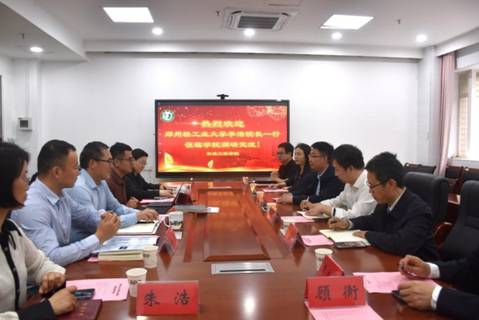
At the symposium, Secretary Pan Hongjun first extended a warm welcome to Dean Li Hao and his delegation from Zhengzhou University of Light Industry on behalf of the school. He pointed out that Zhengzhou University of Light Industry has a long history and distinctive characteristics, and has played an important role in serving local economic construction. He highly affirmed the remarkable achievements made by the School of Mechanical and Electrical Engineering of Zhengzhou University of Light Industry in recent years in the construction of "National Model Party Branch" and the application for first-level discipline doctoral programs. He expressed the hope that the two schools could further strengthen exchanges and cooperation, learn from each other's advanced experiences and practices, and achieve mutual learning and common development.
Dean Zhang Zhongqiang gave a detailed introduction to the school's development history, discipline and professional settings, as well as the achievements made in recent years in faculty team construction, platform construction, scientific research innovation and talent cultivation. He emphasized that the school's discipline directions and professional settings should closely serve the needs of national strategies and local industrial development, and talked about the school's future development ideas and plans around industry-education integration, team construction, and teaching-research integration.
Dean Li Hao first highly praised the outstanding achievements made by our school in recent years. He believed that the school's outstanding achievements in teaching and scientific research are inseparable from the joint leadership of the Party and administration of the school, the in-depth integration of Party building and business work, and the guidance of Party building and ideological and political work on education and teaching. Subsequently, he introduced the historical development and construction of Zhengzhou University of Light Industry and its School of Mechanical and Electrical Engineering from the aspects of school origin, professional settings, discipline construction, Party building work and scientific research innovation.
At the meeting, the two sides conducted discussions and exchanges on education and teaching reform, talent introduction and team management, and the construction of emerging engineering disciplines, shared their respective experiences and practices, and sparked many beneficial ideas.
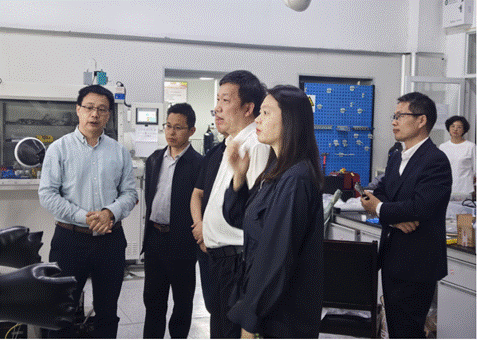
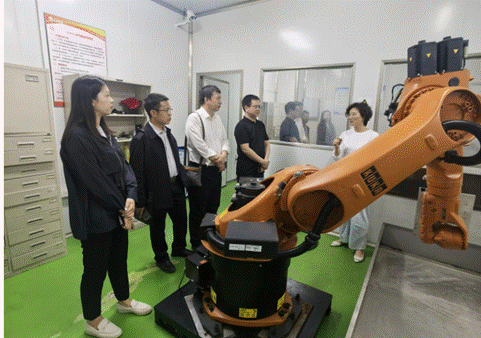
After the meeting, Vice Dean Ye Yunxia and Cheng Guanggui, Dean of the School of Artificial Intelligence Industry, led the delegation to visit the Advanced Laser Manufacturing Laboratory, the Intelligent Flexible Mechatronics Platform and the laboratories of the School of Artificial Intelligence Industry. The guests showed great interest in the advanced equipment, cutting-edge research directions and innovative research achievements of the laboratories, stopped from time to time to ask questions, and highly praised the construction achievements of our school in related fields. They stated that these laboratories provide a good platform and support for scientific research innovation and talent cultivation.
This survey and exchange activity has built a good communication and cooperation platform for the two schools. In the next step, the two sides will take this symposium as an opportunity to further strengthen contacts and exchanges, carry out in-depth cooperation in scientific research projects, accelerate the pace of cooperation in discipline and platform construction, continuously improve the ability to serve national strategies and regional economic development, and jointly make greater contributions to the development of higher education.